What is a Linear Motion Guide?
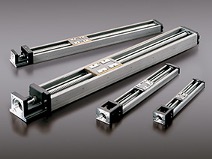
A Linear Motion Guide, also known as an LM Guide, is a mechanical component designed to facilitate the smooth and precise movement of heavy objects in a straight line. It accomplishes this by converting a "sliding" motion into "rolling" motion using ball bearings. These guides are referred to as "recirculating linear ball bearings" by ISO and JIS standards, and as "linear guideways" by the Japan Machine Tool Builders’ Association. THK CO., LTD. calls them "LM Guides."
The fundamental components of a linear guide include a mobile carriage, a supporting rail for the carriage's movement, and ball bearings. The linear motion is achieved by implementing a mechanism that recirculates the balls within the guide. THK's LM Guide, for instance, terms these components as the LM block and LM rail.
The history of the LM Guide dates back to 1944 when the concept of ball bushings was developed in the United States. Initially, ball bushings allowed for infinite linear motion, but they had limitations due to low load capacity and the need for multiple shafts to prevent nut rotation under torque.
To address these limitations, the ball spline was introduced, which featured arc-shaped raceways on the shaft and nut, enabling higher load-bearing capacity and torque transmission. However, it still had some clearance issues. Hiroshi Teramachi, the founder of THK CO., LTD., developed the angular ball spline in 1971 to eliminate clearance problems.
In 1972, Teramachi further improved the design by integrating the shaft onto a base, creating the world's first linear motion ball guide (linear guide), known as the Model LSR. This innovation eliminated precision loss due to deflection and made mounting easier.
Subsequent developments in 1973 and 1975 led to the creation of the Model NSR-BC and NSR-BA, respectively, by combining the spline shaft, mounting base, nut, and housing into integrated LM rails and blocks.
Linear guides find extensive applications in various industries, including machine tools, semiconductor manufacturing, transportation, construction, aerospace, medical devices, and more. They are crucial for guiding linear motion precisely and efficiently.
These linear guide mechanisms involve both guiding and driving elements, with various options like ball splines, linear bushings, slide rails, cross-roller guides for guiding, and mechanisms like ball screws, belts, hydraulics, pneumatics, or linear motors for driving.
Linear guides offer several key characteristics, including:
- No Clearance: Linear guides provide smooth and precise motion without any clearance, making them superior to sliding guides.
- Infinite Linear Motion: The balls in linear guides recirculate endlessly, allowing for strokes as long as the rail itself.
- High Load Capacity: Curved grooves on the raceways of linear guides provide surface contact between the balls and raceways, resulting in a high permissible load, approximately 13 times greater than point-contact components like linear bushings.
THK CO., LTD. has been a pioneer in LM Guide technology since 1972, continuously redefining industry standards by applying the principles of deep-groove ball bearings to linear motion components. Their innovations have significantly increased the permissible load and extended the service life of linear guides.
These guides come in various variations to suit different applications, including radial load and four-way equal load types, wide and miniature types, and even non-linear options like cross guides and curved guides.
To protect LM blocks, THK offers accessories designed to prevent foreign materials from entering and provides lubrication devices to extend maintenance intervals. Some LM Guide products also come with integrated linear encoders.
THK manufactures LM Guides at multiple factories in Japan and worldwide to meet global demand, and they offer custom solutions beyond their catalog products.
Additionally, combining an LM Guide with a drive component like a ball screw enables precise and smooth movement. THK also provides IoT-enabled predictive failure detection services through OMNIedge for LM Guides and other products.
In selecting an LM Guide, one should consider the application, usage conditions, and required load-bearing capacity to determine the appropriate model and size. THK is committed to environmental sustainability and complies with regulations such as the EU RoHS directive.
Choose Technico Inc. and THK products to unlock the full potential of multiple applications in your everyday life.
If you have any questions or inquiries about THK products, please contact us at sales@technico.com or fill out our contact form at https://www.technico.com/contact-us. Our team is ready to assist you with your specific requirements.